Gathering Wisdom at the Two Sessions | CPPCC Member Li Lianzhu Offers Policy Suggestions for High-Quality Development
News 2026-08-28
Profile
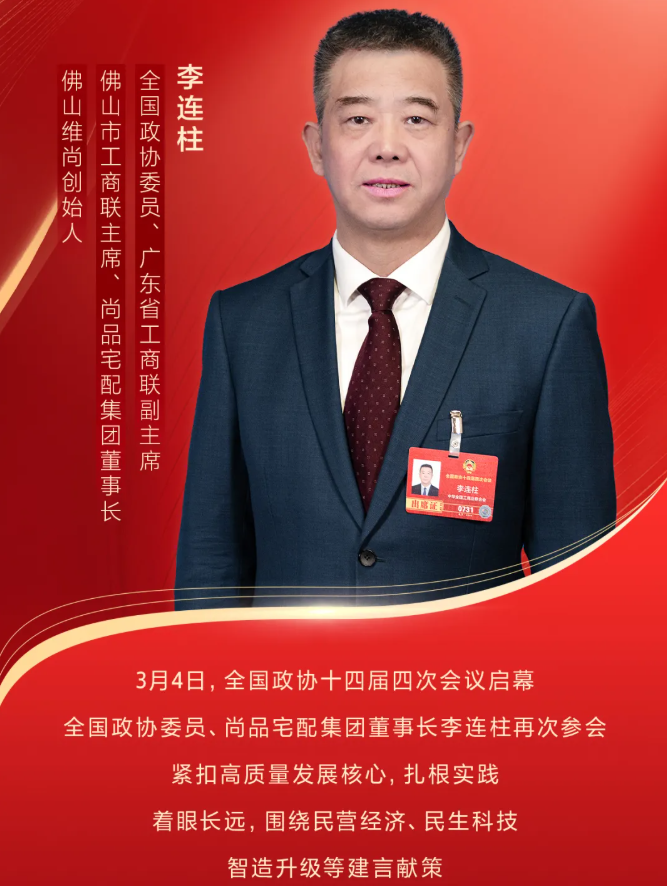
Li Lianzhu
- Member of the CPPCC National Committee; Vice Chairman of the Guangdong Provincial Federation of Industry and Commerce
- Chairman of the Foshan Municipal Federation of Industry and Commerce; Chairman of the Board of Wayes Group
- Founder of Wayes
Opening
On March 4, the Fourth Session of the 14th National Committee of the Chinese People’s Political Consultative Conference (CPPCC) opened.
Li Lianzhu, member of the CPPCC National Committee and Chairman of Wayes Group, attended the session once again. Staying focused on the core of high-quality development and grounded in practical experience, he offered policy recommendations with a long-term perspective on the private economy, people’s livelihood technologies, and smart manufacturing upgrades.
1. Promote a “Warm and Clean” Government-Business Interaction Mechanism to Support High-Quality Development of the Private Economy During the 15th Five-Year Plan
Context
Current government-business interactions often suffer from “many formalities but little warmth,” leaving entrepreneurs still seeking a stronger sense of psychological belonging. For the private economy to thrive during the 15th Five-Year Plan period, it is essential to build a new ecosystem of government-business relations built on emotional integration.
Recommendations
- Institutionalize: The National Development and Reform Commission (NDRC) and the All-China Federation of Industry and Commerce (ACFIC) should lead in formulating guiding opinions, establishing normalized emotional connection mechanisms around holidays and key moments, and encouraging informal exchanges.
- Upgrade evaluation: Incorporate “entrepreneur experience” into the business environment assessment, adding soft dimensions such as psychological distance and sense of belonging, so that governments pay greater attention to “winning hearts.”
- Cultivate culture: Encourage localities to build a “government-business community” culture based on their industrial endowments, making respect for entrepreneurs a defining mark of the city’s spirit.
Key Message: The warmth of governance is also a productive force. Moving from clean institutions to emotional integration will reactivate confidence and vitality in the private economy.
2. Accelerate the Development of the Family Companion Robot Industry and Empower Happy Families Through Technology
Context
China is facing a growing “companionship gap,” with over 130 million empty-nest elderly people living alone and nearly 10 million left-behind children. While maturing AI technologies are laying the foundation for the companion robot industry, the sector still faces bottlenecks in technology, cost, and standards.
Recommendations
- Policy support: The Ministry of Industry and Information Technology (MIIT) and the NDRC should lead in issuing industry guidance, providing R&D policy support, and including age-friendly products in subsidies for age-friendly renovations.
- Technology breakthroughs: Co-build national laboratories to overcome core technologies and cultivate interdisciplinary talent in AI + psychology.
- Scenario deployment: Conduct large-scale pilots in community elderly care and child welfare institutions, and develop standardized functional modules integrated into public services.
- Model projects: Support the Guangdong-Hong Kong-Macao Greater Bay Area and the Yangtze River Delta in building demonstration zones, forming a closed loop from technology R&D to inclusive promotion, and exporting the “China solution.”
Key Message: Use technology to fill the family companionship gap, make companion robots a “new member of the family,” and cultivate new growth points in the people’s livelihood technology industry.

Wayes in Practice
With years of deep engagement in the industry, Wayes has served more than 10 million families, accumulating vast amounts of home-scenario demand data and experience logic, and precisely grasping the core needs of home interaction. In 2025, Wayes established in-depth cooperation with a leading Chinese embodied-intelligence robotics company, focusing on deploying robotics technology in two major scenarios—home and commercial—to fill the family companionship gap.
In the home scenario, intelligent robots integrate cleaning and storage, emotional companionship, children’s education, and safety guardianship. Through scenario-based data training, they achieve user-habit awareness and intelligent interaction, upgrading the home into a “thinking and responsive” smart space. In the commercial scenario, robots are deployed in stores to handle guided tours and product explanations, improving efficiency and driving traffic.
By tackling core challenges such as home robot training simulation and data collection, Wayes is driving robotics into whole-home customization and integrated decoration services, building a “data + hardware + service” closed loop and upgrading the smart home ecosystem.
3. Support the Deep Integration of AI and 3D Printing to Build a New Ecosystem of Personalized Home Service-Oriented Manufacturing
Context
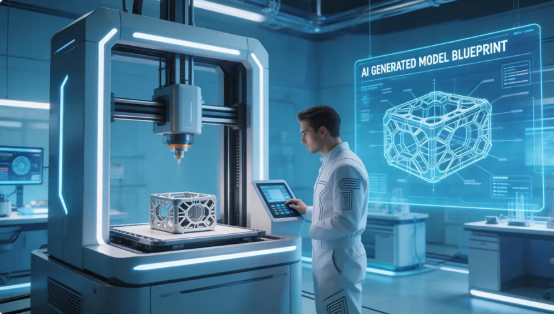
The state has explicitly promoted the integration of advanced manufacturing and modern services and the development of new quality productive forces. AI + 3D printing is a key breakthrough for service-oriented manufacturing. Wayes has already achieved a closed loop of technology, scenarios, and commerce, pushing custom home furnishing from basic to advanced customization.
Recommendations
- Demonstration programs: MIIT should create a separate “AI + 3D Printing” category in service-oriented manufacturing demonstration selections, promoting the China solution to the consumer goods industry.
- Platform co-construction: Build a national-level cloud platform for personalized home intelligent manufacturing, lowering the technology threshold for SMEs and creating a “platform + ecosystem” model.
- People’s livelihood-driven inclusion: Include age-friendly and child-friendly 3D-printed home products in government procurement and people’s livelihood project catalogs.
- Standards and norms: The State Administration for Market Regulation (SAMR) and MIIT should lead in formulating safety and environmental standards for 3D-printed home products to protect consumer rights.
Key Message: 3D printing drives a qualitative leap in custom home furnishing. AI + 3D printing can unlock a trillion-scale personalized market, advance “Made in China” toward “Smart Made in China” and “Created in China,” and provide solid support for a better life for the people.
Wayes in Practice
As a leader in technological innovation for custom home furnishing, Wayes uses AI design factories and flexible production systems to build end-to-end digital capabilities spanning “design—production—delivery—service,” forming a unique scenario advantage.
In 2026, Wayes entered into a strategic partnership with Bambu Lab, a global leader in consumer-grade 3D printing, achieving complementary core values and mutual empowerment, and is committed to co-building China family 3D printing maker spaces. Through “downloadable” customization and iteration of furniture functional components, it precisely meets the needs of groups such as the elderly and children, upgrading home products from standardized industrial goods to life solutions that carry both emotion and function.
Going forward, Wayes will continue to deepen the integration of AI and flexible production, forming a virtuous cycle between scenarios and technology, promoting large-scale personalized customization upgrades across the industry, and leading custom home furnishing’s transformation from “mass manufacturing” to “intelligent creation.”
4. Guard Against AI Employment Risks and Improve the Protection Mechanism for Workers’ Transition
Context
AI technology is reshaping production methods, delivering a dual impact of “structural reshaping” and “intensified labor-capital conflicts” on the employment market. Job displacement is outpacing skill restructuring, and the costs of corporate transformation tend to be one-sidedly passed on to workers, making employment structural imbalance increasingly prominent.
Recommendations
- Risk prevention and control: The Ministry of Human Resources and Social Security (MOHRSS) should lead the construction of a national-level dynamic monitoring platform for AI’s employment impact, issue red-yellow-blue three-level warnings for high-risk industries, and build a “monitoring—warning—response” system.
- Skill upgrading: Implement a “skills bank” system, establish lifelong personal vocational skills accounts, and co-build training bases between schools and enterprises to deliver customized reskilling programs that enhance workers’ irreplaceable capabilities.
- Cost sharing: Establish a “technology transition social buffer fund,” financed through contributions from relevant enterprises or dedicated funds, to subsidize training, living expenses, and entrepreneurship for affected workers.
- Rights protection: MOHRSS and the Supreme People’s Court should jointly issue guidelines on handling labor relations, clarify corporate obligations, improve social security for new forms of employment, and provide public-service job placements as a safety net for groups struggling with transition.
Key Message: Developing AI is meant to liberate and empower people. Through institutional innovation, we must balance efficiency and fairness, strengthen the foundation of social justice, realize “technology for good and development for the people,” and consolidate the human capital foundation for Chinese modernization.
Conclusion
CPPCC Member Li Lianzhu’s proposals are not only industry reflections drawn from corporate practice, but also a responsibility anchored in national development.
As a pioneer in smart manufacturing for custom home furnishing, Wayes is now laying out new quality productive forces with AI + 3D printing at the core. Going forward, the company will continue to empower smart manufacturing through technological innovation, practice responsibility with warmth, and contribute the home furnishing industry’s strength to high-quality development!Translated from the WeChat article by Wayes (Official), published March 6, 2026.